
Know who owns each duty and what each gate needs
On a capital programme, who is responsible for what is spread across contracts, statutes and governance documents, and much of the reasoning sits with the people doing the work, so we set out how your programme is meant to run: who holds each duty at each stage, what each gate needs and what evidence each step should produce. Gate readiness then builds up as the work proceeds, instead of being assembled when the review is due.

The method behind a programme is rarely written down
Schedules and documents are recorded, but the responsibilities, duties and reasoning that connect them usually are not.
A capital programme passes through many hands. Sponsors, client teams, designers, contractors and specialist duty-holders each take decisions that others depend on. Responsibilities are set out in contracts, statutes and governance documents, but rarely in one place, and rarely in a form that shows who signs off what at each stage.
When the people who understood the arrangements move on, the organisation is left with the documents but not the method. Gate reviews then depend on assembling evidence after the event, and accountability for a given duty can be hard to establish when it matters most.
Governance is spread across contracts, statutes and roles
Each source is clear enough on its own; the difficulty is in how they combine on a particular programme.
One workflow from the delivery model
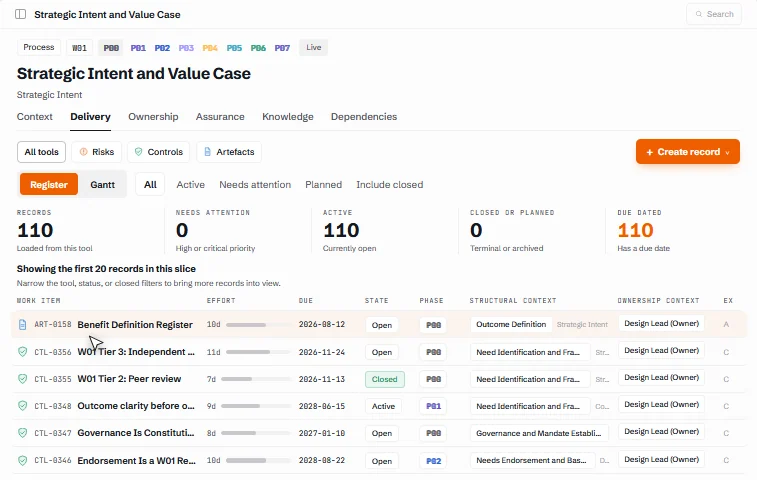
This is one of the 23 workflows in the delivery model: the strategic intent and value case. Each point is an artefact, control, risk, role or phase. Each line is a dependency, an ownership or a sign-off.
- Workflow
- Sub-process
- Phase
- Role
- Artefact
- Risk
- Control
- Interface
- Reference
How the work runs
We start from how the programme is meant to be governed, and then check that the work actually follows it.
- Understand the programmeAgree with the sponsor and client team the programme's structure, contract forms, regulatory regimes and the decisions that matter most.
- Map roles and dutiesSet out each role, responsibility and statutory duty stage by stage, so each sign-off has a named owner.
- Align to the contractConfigure the governance to the contract forms in use, so it follows the arrangements already chosen.
- Link steps to evidenceConnect each step to the evidence it should produce, so gate readiness is built up as the work proceeds.
- Review and improveCheck the work is being done the way the process says, and adjust the process where practice shows it should change.
This draws on a mapped model of the full delivery lifecycle: 8 phases, 23 workflows and 262 sub-processes, with the roles, statutory duties and gates behind them.
What we put in place
How deep each of these goes depends on the programme's stage, its regulatory regime and how much governance already exists.
What a sponsor gets from it
What a sponsor can expect to know as a result, and the decisions it is then better placed to take.
What the work draws on
What has been built so far, and what it draws on.
Project:OS
A mapped delivery model
The model behind Project:OS was counted in September 2026. Its most complete layer is the governance backbone: who does what, at which stage, under which contract and which law, and who signs it off.
- 111 roles, joined by 1,461 responsibility (RACI) links and 540 statutory-duty links
- 79 contract forms, including the full NEC4 family, JCT, 8 FIDIC books, PPC2000 and FAC-1/TAC-1
- 704 gate links and 590 sign-off links
Research
Consenting as a governed process
The Consenting at speed worked example shows the same approach applied to one part of the lifecycle, with consenting set out as nine connected sub-processes, each with an owner.
Founders' earlier work
Commercial processes on Hinkley Point C
Before founding Synaform, our founders developed a machine learning pilot for Hinkley Point C in 2019, as part of a digital transformation of commercial processes.
The services and software behind it
Strategic and operational advisory works with sponsors on governance, assurance and the operating model of the client organisation. Process and organisational improvement looks at how decisions, handovers and sign-offs actually happen, since documenting a poorly designed process does not of itself improve it. Data, integration and implementation links the governance model to the document, schedule and reporting systems already in use.
Common questions
If yours is not here, ask us directly.
Who is this for?
Organisations that own and pay for major capital programmes: asset owners and operators, government and local authorities, and the senior responsible owners who take programmes through gate reviews. It suits regulated duty-holder regimes in particular, such as building safety, nuclear, reservoirs and COMAH, because those duties are mapped role by role.
Do we have to change our contract or our systems?
No. The governance follows the contract form you have chosen, and the duties of 79 contract forms are already mapped. The process can run in Project:OS or be set up in the systems you already use.
How is this different from a project management tool?
Most tools hold the schedule and the documents. This work sets out the method behind them: which role owns which duty, under which contract and statute, and which gates each stage must pass.
Around that method sit the parts of governance that usually live in separate spreadsheets: who is responsible, accountable, consulted and informed for each activity; the risks that belong to each step, with their controls and owners; the people and capacity each role needs; and the artefacts each gate expects to see.
Because they are held in one model, they stay connected. A resourcing gap shows against the work it affects before that work arrives, a risk sits beside the control and the person responsible for it, and a change to a role or a gate shows wherever it applies. Where your schedule and document tools already work, they stay in place, with the method behind them.
Can it show we're ready for a gate review?
It assembles the evidence for each gate against set criteria, so you can see what a gate needs, who signs it off and what is still missing. It supports gate readiness. It is not an independent assurance review and does not replace one.
Talk to us about a programme
Tell us about the programme, the gates ahead and where accountability feels unclear. We can help work out where to begin.
Start a conversation