
PFI handbacks, de-risked
Developed in collaboration with A7Consult Limited, this work catalogued 720 UK PFI and PF2 projects and rebuilt four contracts from published records alone, to show how much an authority can know about its asset before handback.
How we approached it
A great deal more can be known about an asset before handback than most people expect, provided the gaps are shown as gaps.
- Status
- Research, developed in collaboration with A7Consult Limited
- Purpose
- Show what an authority can learn about its asset from the public record before handback
- Sector
- Local government, NHS trusts, devolved administrations, central government, police and fire
- Scope
- UK national catalogue; four contract models in England
- 720
- PFI and PF2 projects catalogued
- 65
- Contracts expiring in the peak year, 2036
- 4
- Contracts rebuilt from the public record
How we went about it
Why we did the work
PFI contracts end on fixed dates, and the wave of expiries is now close.
When a PFI contract ends, the building or network, its records and whatever is left of its obligations come back to the public body. On the government's register as at 31 March 2025, 299 contracts expire between 2032 and 2037, with the peak of 65 in 2036.
How the work was built
Three pieces of work, each of them built from published sources.
For each contract there is a register of facts cited to document and page, and a list of questions to put at handback. Sources were planning files, released contracts, energy certificates, committee papers and Environment Agency LiDAR. We made no information requests of our own and used no client archives.
What the public record showed
More than most people expect. At the school campus, the energy certificates record renewable heat in one year only between 2011 and 2025. At the hospital, NHS estates returns show the wood-chip boiler's renewable fuel falling to nil from 2018/19. At the energy-from-waste plant, the released contract shows the plant transfers at expiry for no additional payment, and that the handback test is maintained condition, not remaining life. For the lighting network, the rebuilt register reproduced all 60 of the published asset counts.
Idle renewable plant is now a standard question on each model we build.
Gaps in the public record show as gaps in the model rather than as guesses.
From a national catalogue to four rebuilt contracts
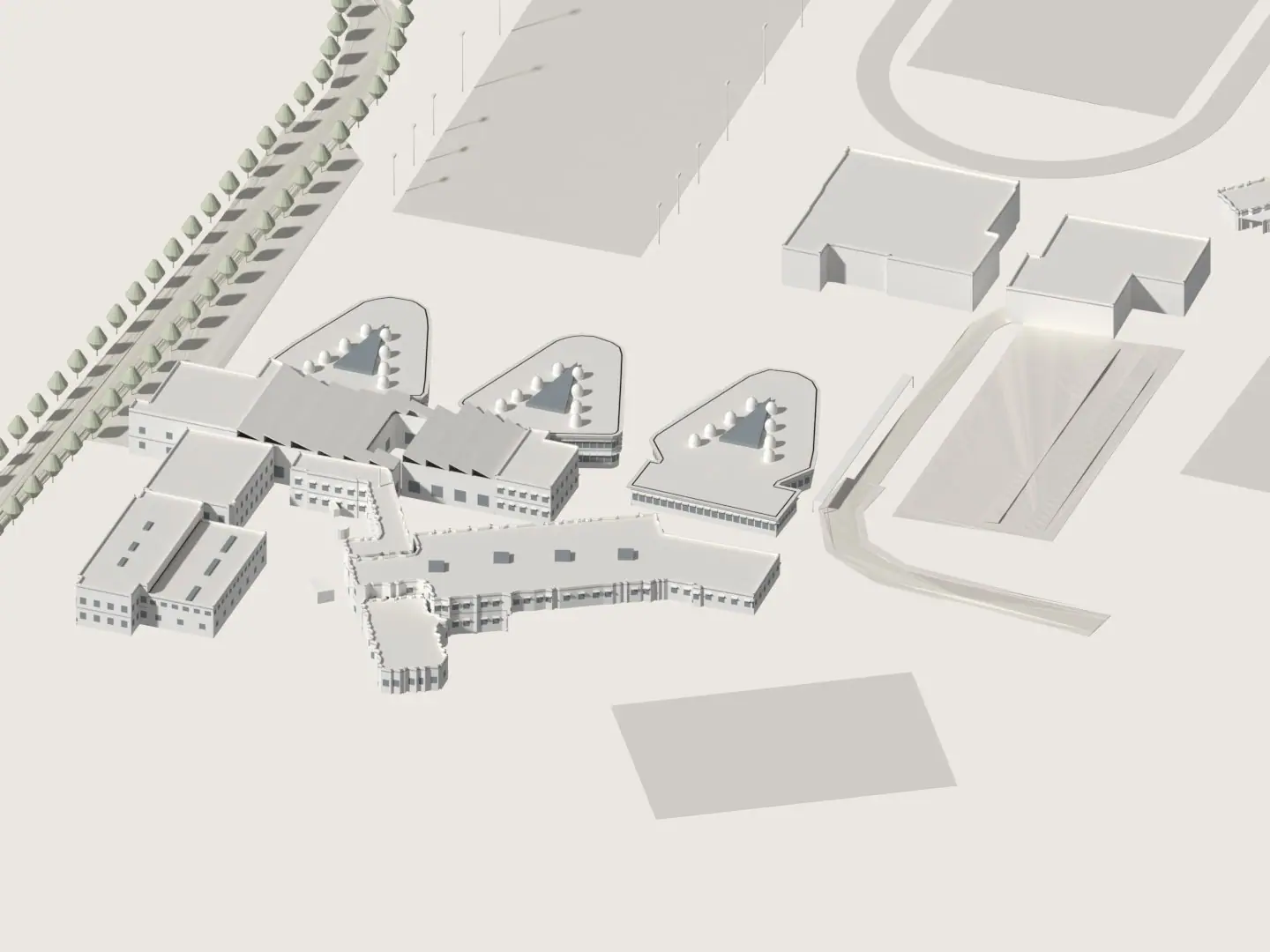
The school campus model
The school campus, rebuilt from published records. Turn it, and then colour it by evidence: the darker the part, the firmer the record behind it.
- Stated or drawn on a published document319
- Scaled from a published drawing97
- Measured from LiDAR190
- Inferred from the published record4,162
- Assumed: no record found368
Select any part of the model to see what it is and where the information came from.
Exterior and site components shown; internal partitions and doors are left out to keep the file small. The ground is shown only as shadow. Where a part is marked as assumed, the published record holds nothing on it, and a survey or the provider's records should replace it.
What a public-record model can and cannot tell you
The method is only as complete as what has been published, and it is deliberately designed to show where that runs out.
- Published sources only. No information requests, client archives or site access were used, so anything not in the public record is absent from the models.
- Elements are tagged. Each element records whether it comes from drawings, a survey, LiDAR or a stated assumption, so what is assumed is visible.
- Gaps are shown rather than filled. Where the record is silent, the model simply shows the gap.
- A national picture at a date. The catalogue is based on HM Treasury's register at 31 March 2024 plus devolved projects, and will drift as contracts are varied, terminated or extended.
- Not a condition survey. A model built from documents and LiDAR shows what the record says about an asset. Current physical condition still has to be established on site.
Related solutions and services
The same method underpins the support we give to authorities approaching expiry.
Talk to us about a contract approaching expiry
If a PFI contract is approaching expiry, we can help establish what the public record already says about the asset and what still needs to be asked.
Start a conversation