
Ports, configured by demand
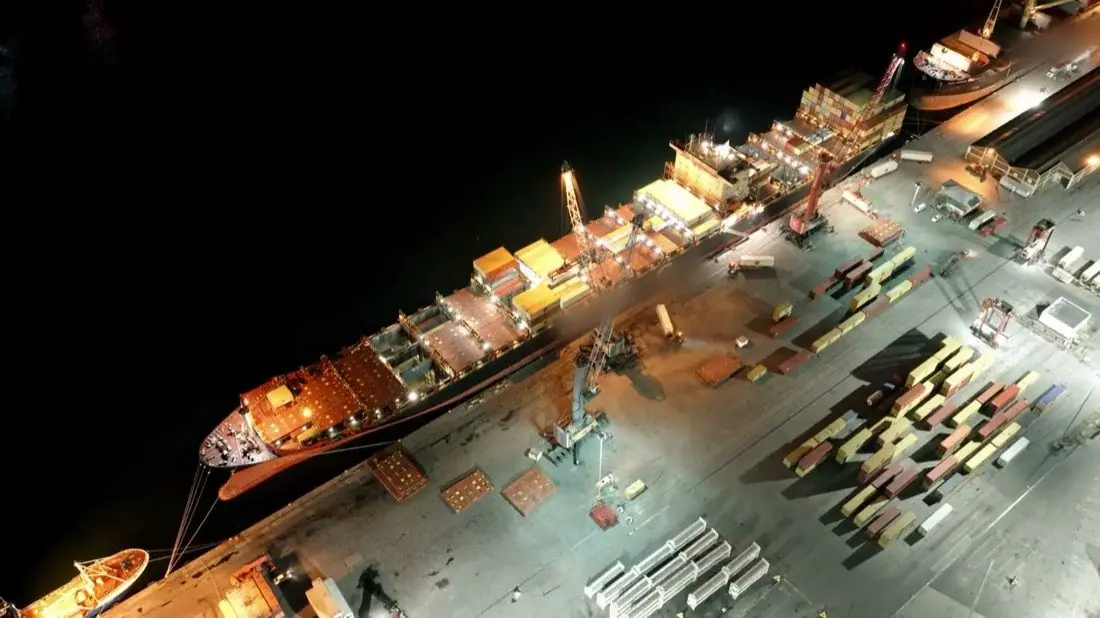
A port options configurator that links customer demand to marine and landside requirements. It starts with the vessels and cargo a terminal has to handle, works out what the port must provide at the berth and behind it, and prices what that costs to build and run.
What the configurator is for
Start from the demand the asset has to serve, and let the berth, the yard and the gate follow on from it.
- Status
- Illustrative model
- Purpose
- Establish how big a port terminal needs to be, what kind, and what it costs to build and run
- Sector
- Ports
- Scope
- Demand, marine and landside requirements, capital and operating cost
The configurator answers the first question on a port scheme: how big, and what kind. It shows how we use systems modelling early, when the options are still open and the cost of changing direction is low.
- 4
- Requirement sets: demand, marine, landside and cost, linked
- Live
- Each input recalculates as it changes
- CAPEX and OPEX
- Capital and annual operating cost for each option
How we went about it
Starting from demand
Before anyone compares pile types or deck systems, somebody has to decide what the terminal is actually for.
The configurator starts with the customer's demand: how many vessel calls a week, how much cargo each one brings, how long it stays on the terminal and how sharp the peak is. From those inputs it works out what the port has to provide, at the berth and behind it, and what that costs to build and run.
Options can be saved, and the results export to spreadsheet and PDF with the inputs, quantities and cost breakdown.
How the configurator works
A change in demand flows straight through to space, structures and cost.
- DemandVessel calls per week, cargo per call, import and export share, dwell times and the peak factor.
- MarineBerth type (quay wall or jetty), quay length, dredging and bed levelling.
- LandsideStorage area at set densities, open or multi-storey storage, roads, load lanes and bays, and the buildings and plots the terminal needs.
- CostDirect capital cost from an editable unit-cost library, allowances for preliminaries, design, risk and contingency, and annual operating cost.
Best-practice options can be switched on and priced in the same model, including stormwater treatment, EV readiness, solar canopies and a digital yard.
What comes next
Illustrative model
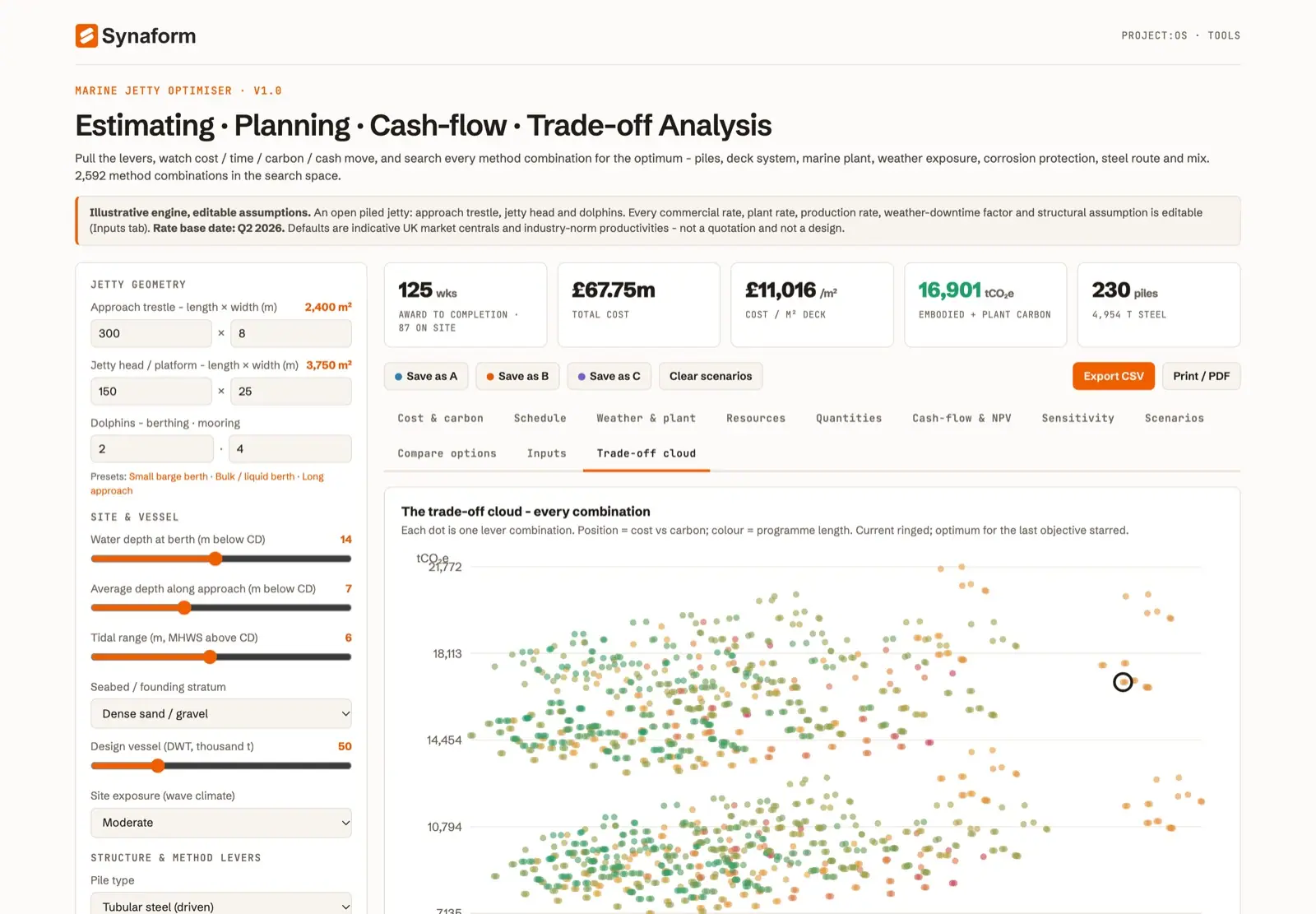
The Marine Jetty Optimiser picks up the next question. It takes a jetty and compares ways of building it on cost, time, carbon and cash: pile type, deck system, marine plant, corrosion protection, steel route, concrete mix and shift pattern. It can search every combination for the lowest cost, the fastest programme, the lowest carbon or a balance of the three.
Its default rates are rounded benchmarks, indexed to 2026 prices, and each rate can be replaced with project figures. A demonstration is available on request: ask to see the optimiser.
What the configurator does and does not claim
It sizes and prices options for comparison at an early stage, and it is not a design or a cost plan.
- A generic terminal. This version is not set up for any particular port. Inputs are the user's, and the results are only as good as the demand assumptions behind them.
- Set densities. Storage area is calculated at set densities, so it reflects an assumed way of operating the yard.
- Unit costs and allowances. Capital cost comes from an editable unit-cost library plus allowances for preliminaries, design, risk and contingency. The library needs checking against current rates before results are relied on.
- Early-stage sizing. The outputs indicate scale and cost for comparing options. Ground conditions, navigation, environmental constraints and consenting are outside its scope.
Related solutions and services
Capacity questions like this one sit somewhere between modelling and advice.
Talk to us about sizing a scheme
If a scheme has to be sized before its options can be compared, we can help set out the demand and test what follows from it.
Start a conversation